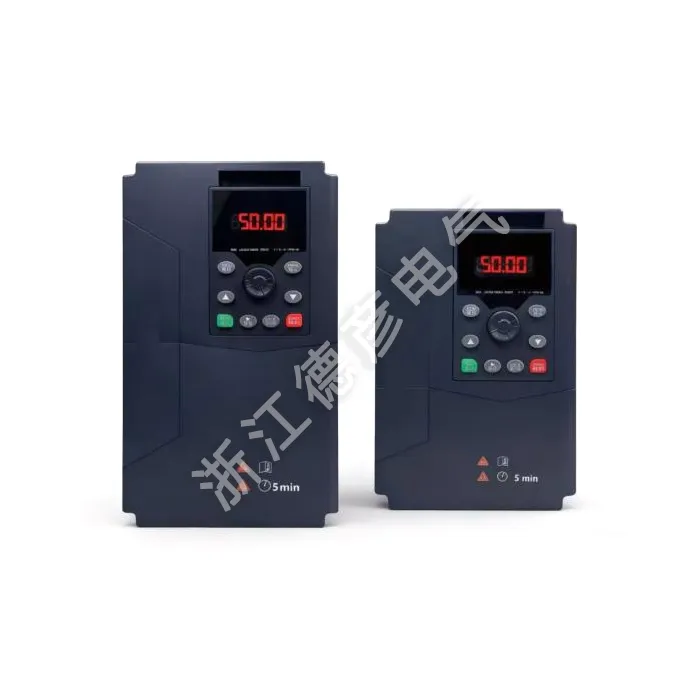
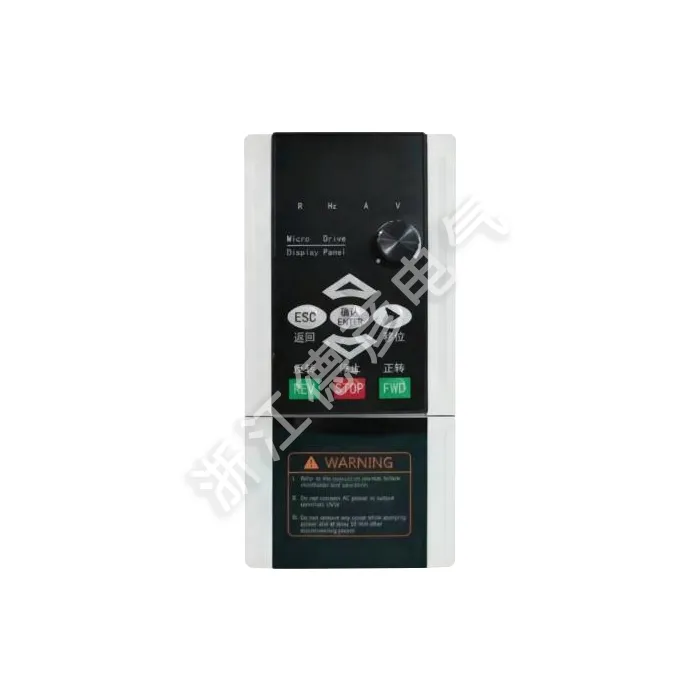
Deyan Electric is a professional industrial electrical supplier, providing reliable solutions and good price advantage, covering European and American markets. Its LNC860L series frequency converter with automatic roll diameter calculation is engineered specifically for wire drawing, winding and unwinding production lines where reel diameter keeps changing during operation. Unlike general-purpose frequency converters that require external PLC or separate tension controllers to handle diameter variation, this unit integrates a built-in mathematical model for tension winding control right inside the drive. It tracks spool diameter in real time and dynamically adjusts output torque and speed, keeping material tension constant from empty spool all the way to fully wound coil. This eliminates the most common causes of production loss — wire breakage, uneven material thickness, wrinkled foil and messy coil winding — that happen when tension drifts as roll diameter changes.
For factory operators and maintenance technicians, the biggest headache on winding-unwinding lines is this: you set everything perfectly when the spool is empty, but as material builds up layer by layer, tension slowly goes out of control. By the time the reel is nearly full, you are dealing with snapped wire, stretched plastic filament, or foil that creases so bad whole batches get scrapped. Traditional solutions add extra hardware — diameter sensors, external PLC modules, separate tension controllers — which means more wiring, more things that can break, and more money spent on engineering. This frequency converter solves the problem at the source by putting the roll-diameter calculation logic inside the drive itself, so you need fewer components and get more stable results.
Why Roll Diameter Matters
Most people do not realize how much a changing reel diameter affects production quality. In a typical winding process, the spool starts nearly empty and ends up holding kilograms or even tons of material. If the drive keeps running at a fixed torque setting throughout, tension will keep rising as diameter grows. The result is not just poor product quality — it is real financial loss.
● Material breakage: When tension gets too tight, thin wire, fine filament or delicate foil snaps mid-run. You lose whatever material was on the line, plus the time spent re-threading and restarting.
● Uneven product dimensions: Stretched wire or filament comes out thinner than specification. The finished product fails quality checks and cannot be shipped to customers.
● Wrinkling and creasing: On foil and thin strip lines, tension overshoot causes permanent crease marks. The material is ruined, sometimes an entire production run has to be scrapped.
● Messy coil winding: If tension is too loose, material winds unevenly on the spool. Coils arrive at the customer's site looking sloppy, and unwinding later causes tangles and downtime.
● Mechanical wear: Constant tension shock puts extra stress on bearings, gears and shafts. Equipment wears out faster and maintenance costs go up over time.
These are not rare problems — they happen every single day on production lines that use standard inverters without proper diameter compensation. The root cause is simple: the drive does not know how big the reel has become, so it cannot adjust torque accordingly.
How Auto Calculation Works
The frequency converter with automatic roll diameter calculation uses a built-in mathematical model for tension winding control. Instead of relying on external diameter sensors or separate control modules, the drive computes real-time spool diameter internally based on motor speed, line speed reference and winding logic parameters. It then adjusts output torque and speed automatically to maintain constant tension throughout the entire winding cycle.
Core Working Principle
Inside the drive, a dedicated winding algorithm continuously calculates the current roll diameter using the relationship between motor rotational speed and material line speed. As diameter increases, torque output rises proportionally so that tension on the material stays the same. The calculation runs in real time, updating constantly as the spool fills up. No operator intervention is needed — you set the target tension once at the start, and the drive handles everything else automatically.
What You Get Without Extra Hardware
Because the calculation logic is built into the frequency converter itself, you do not need to add external PLCs, diameter-measuring sensors or separate tension controllers. This simplifies your control cabinet design, reduces wiring work, and cuts down the number of components that could fail. For retrofit projects on existing machines, it means you can upgrade performance without major mechanical changes — just replace the old drive and set up the winding parameters.
Open-Loop and Closed-Loop Both Supported
The automatic roll diameter calculation works in both open-loop and closed-loop tension control modes. For simpler applications or budget-sensitive retrofit projects, open-loop mode delivers solid performance using the internal mathematical model alone. For high-precision production such as ultra-fine wire drawing or thin foil processing where tension accuracy is critical, you can add an encoder and switch to closed-loop mode for even tighter control. Either way, the diameter calculation function is active and working to keep tension stable.
Model Meaning
Each model number in the LNC860L series carries specific information about voltage class, power rating and product type. Understanding the naming convention helps you select the right unit quickly when ordering.
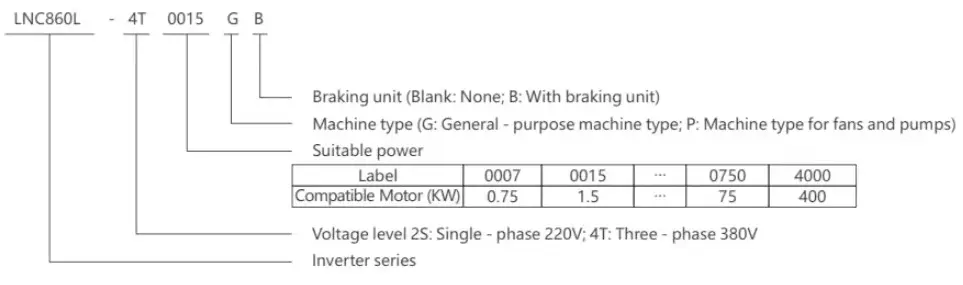
Nameplate Details
Every unit ships with a standard nameplate label showing key electrical ratings. Below is a reference example of what appears on the product label.
|
MODEL:
|
LNC860L-4T0037GB/4T0055PB
|
|
POWER:
|
3.7KW 9A/5.5KW 13A
|
|
INPUT:
|
3PH AC380V 50HZ/60HZ
|
|
OUTPUT:
|
3PH ACOV-380V OHZ-400HZ
|
|
S.N:
|
Barcode
|
Full Model Lineup
The series covers a wide power range from 0.75kW all the way up to 400kW, with both single-phase 220V and three-phase 380V options available. This means you can find a matching unit for small test machines and large industrial production lines alike.
|
Frequency converter model
|
Power capacity(kVA)
|
Input current (A)
|
Output current (A)
|
Applicable motor(KW)
|
|
Single-phase power supply: 220V±15%, 50/60Hz
|
|
LNC860L-2S0007GB
|
1.5
|
8.2
|
5.0
|
0.75
|
|
LNC860L-2S0015GB
|
3.0
|
14.0
|
7.0
|
1.5
|
|
LNC860L-2S0022GB
|
4.0
|
23.0
|
9.6
|
2.2
|
|
Three-phase power supply: 380V±15%, 50/60Hz
|
|
LNC860L-4T0007GB
|
1.5
|
3.4
|
2.1
|
0.75
|
|
LNC860L-4T0015GB
|
3.0
|
5.0
|
3.8
|
1.5
|
|
LNC860L-4T0022GB
|
4.0
|
5.8
|
5.1
|
2.2
|
|
LNC860L-4T0037GB
|
5.9
|
10.5
|
9
|
3.7
|
|
LNC860L-4T0055GB
|
8.9
|
14.6
|
13
|
5.5
|
|
LNC860L-4T0075GB
|
11
|
20.5
|
17
|
7.5
|
|
LNC860L-4T0110GB
|
17
|
26
|
25
|
11
|
|
LNC860L-4T0150GB
|
21
|
35
|
32
|
15
|
|
LNC860L-4T0185GB
|
24
|
38.5
|
37
|
18.5
|
|
LNC860L-4T0220GB
|
30
|
46.5
|
45
|
22
|
|
LNC860L-4T0300G
|
40
|
62
|
60
|
30
|
|
LNC860L-4T0370G
|
57
|
76
|
75
|
37
|
|
LNC860L-4T0450G
|
69
|
92
|
91
|
45
|
|
LNC860L-4T0550G
|
85
|
113
|
112
|
55
|
|
LNC860L-4T0750G
|
114
|
157
|
150
|
75
|
|
LNC860L-4T0900G
|
134
|
180
|
176
|
90
|
|
LNC860L-4T1100G
|
160
|
214
|
210
|
110
|
|
LNC860L-4T1320G
|
192
|
256
|
253
|
132
|
|
LNC860L-4T1600G
|
231
|
307
|
304
|
160
|
|
LNC860L-4T2000G
|
250
|
385
|
377
|
200
|
|
LNC860L-4T2200G
|
280
|
430
|
426
|
220
|
|
LNC860L-4T2500G
|
355
|
441
|
465
|
250
|
|
LNC860L-4T2800G
|
396
|
495
|
520
|
280
|
|
LNC860L-4T3150G
|
445
|
565
|
585
|
315
|
|
LNC860L-4T3550G
|
500
|
617
|
650
|
355
|
|
LNC860L-4T4000G
|
565
|
687
|
725
|
400
|
Side-by-Side Comparison
When choosing a drive for winding or unwinding applications, the difference between a standard general-purpose inverter and a dedicated frequency converter with automatic roll diameter calculation shows up clearly in real production results. The table below compares them across the factors that matter most to factory owners and production managers.
|
Comparison Point
|
Standard General-Purpose Inverter
|
Frequency Converter with Auto Roll Diameter Calculation
|
|
Roll diameter handling
|
No built-in diameter calculation. Must add external PLC, sensors or separate tension controller to compensate for changing spool size.
|
Built-in mathematical model computes diameter internally. No extra hardware needed. Torque adjusts automatically as spool fills.
|
|
Tension consistency
|
Tension drifts as diameter changes. Operators must adjust parameters manually, and quality varies between empty and full spool.
|
Constant tension maintained from empty spool to full coil. Automatic real-time adjustment, no manual intervention needed.
|
|
System cost
|
Lower drive price, but total cost rises when you add PLC, sensors, tension controller and extra engineering time.
|
All core functions inside one unit. Fewer components, simpler cabinet design, lower overall system investment.
|
|
Commissioning time
|
Long setup time. Technicians must program external controllers and tune the whole system step by step.
|
Pre-loaded winding parameters. Basic setup takes much less time, especially for retrofit projects.
|
|
Scrap rate
|
Higher scrap rate from wire breakage, wrinkling and dimension variation caused by tension drift.
|
Significantly lower scrap rate. Stable tension throughout the winding cycle means more usable finished product.
|
|
Failure points
|
More components mean more things that can go wrong — sensor failures, communication errors, PLC faults.
|
Simplified system with fewer components. Fewer failure points, easier for on-site staff to maintain.
|
|
Retrofit difficulty
|
Hard to retrofit old machines. Often requires mechanical changes to add sensors and extra wiring.
|
Easy retrofit. Just replace the existing drive and configure winding parameters — no major mechanical work required.
|
Where It Works Best
Any production process where material winds onto a spool or unwinds from one can benefit from automatic roll diameter calculation. The function is especially valuable in these industries and applications:
1. Wire drawing industry: Copper, aluminum and steel wire drawing lines where consistent wire diameter is critical. Automatic diameter compensation prevents wire breakage and thickness variation during the drawing and take-up process.
2. Wire and cable manufacturing: Cable stranding, cabling and take-up lines. Stable tension ensures that cable conductors and insulation layers are not stretched or damaged during winding.
3. Metal foil and strip processing: Aluminum foil, copper foil and thin steel strip lines. Even tiny tension fluctuations cause permanent creases on thin material, making diameter compensation essential.
4. Plastic filament production: Plastic monofilament and synthetic fiber drawing. Soft plastic material stretches easily under excess tension, ruining dimensional accuracy.
5. General winding and unwinding stations: Any reel-to-reel process where material quality depends on steady tension, from textile processing to packaging material production.
Across all these applications, the core benefit stays the same — better product quality, less wasted material, and fewer unexpected production stops caused by tension-related problems.
Technical Specifications
Below is the complete technical specification sheet covering control characteristics, operating characteristics and environmental requirements. All values are based on standard factory testing conditions.
|
Item
|
Specification
|
|
Control characteristics
|
Output frequency
|
0-500Hz
|
|
Carrier frequency
|
0.8kHz~12kHz. The carrier frequency can be automatically adjusted according to the load characteristics
|
|
Output frequency resolution
|
0.01Hz
|
|
Control mode
|
Open-loop vector control (SVC), V/F control, Closed-loop vector control (FVC)
|
|
Torque characteristics
|
With torque compensation and slip compensation, the starting torque can reach 150% at 0.5Hz
|
|
Torque control accuracy
|
±5% (FVC)
|
|
Stall prevention action criterion
|
Set as a percentage of the rated current, ranging from 20% to 250%
|
|
Speed regulation range
|
1:100 (SVC), 1:1000 (FVC)
|
|
Speed stabilization accuracy
|
±0.5% (SVC), ±0.02% (FVC)
|
|
Overload capacity
|
150% of the rated output current for one minute
|
|
V/F curve
|
Four modes: linear, multi-point, complete V/f separation, incomplete V/f separation
|
|
Acceleration and deceleration curve
|
Linear or S-curve acceleration and deceleration modes; four acceleration and deceleration times; acceleration and deceleration time range 0.1~6500.0s
|
|
DC braking
|
DC braking frequency: 0.00Hz~maximum frequency. Braking time: 0.0s~60.0s, braking action current value: 0.0%~100.0%
|
|
Jog control
|
Jog frequency range: 0.00Hz~maximum frequency, jog acceleration and deceleration time 0.1s~6500.0s
|
|
Simple PLC, multi-step speed operation
|
Up to 16-step speed operation can be achieved through the built-in PLC or control terminals
|
|
Built-in PID
|
It can easily realize the process-control closed-loop control system
|
|
Automatic voltage regulation (AVR)
|
When the grid voltage changes, it can automatically maintain a constant output voltage
|
|
Fast current-limiting function
|
Minimize over-current faults to the greatest extent and protect the normal operation of the frequency converter
|
|
Operating characteristics
|
Operating command channel
|
Three channels: given by the operation panel, given by the control terminals, given by the serial communication port. It can be switched in various ways
|
|
Frequency source
|
Ten frequency sources: given by panel knob, given by operation panel, given by analog voltage, given by analog current, given by RS485 communication, which can be switched in various ways
|
|
Auxiliary frequency source
|
Ten auxiliary frequency sources. It can flexibly achieve auxiliary frequency fine-tuning and frequency synthesis
|
|
Input terminals
|
Six digital input terminals, one of which can be used as a high-speed pulse input. Two analog input channels, AI1: input range 0~+10V, AI2: input range 0~+10V/0-20mA
|
|
Output terminals
|
One high-speed pulse output terminal, outputting square-wave signals from 0kHz~50kHz, which can realize the output of physical quantities such as set frequency and output frequency. One digital output terminal. One relay output terminal. Two analog output terminals: 0V~10V/0-20mA, which can indicate the output of output frequency/current/voltage/frequency command/rotational speed/power factor signals
|
|
Protection function
|
Motor short-circuit detection upon power-on, input and output phase-loss protection, over-current protection, over-voltage protection, under-voltage protection, over-heat protection, overload protection, etc
|
|
Environment
|
Application place
|
Indoors, not directly exposed to sunlight, free from dust, corrosive gases, flammable gases, oil mist, water vapor, dripping water or salt, etc
|
|
Altitude
|
Less than 1000m
|
|
Ambient temperature
|
-10℃~+40℃ (When the ambient temperature is between 40℃~50℃, derating operation is required)
|
|
Humidity
|
Less than 95%RH, without water droplet condensation
|
|
Vibration
|
Less than 5.9m/s² (0.6g)
|
|
Storage temperature
|
-20℃~+60℃
|
FAQ
Q: Do I need to install diameter sensors or an external PLC for roll diameter calculation?
A: No, you do not. The frequency converter with automatic roll diameter calculation has a built-in mathematical model for tension winding control that computes spool diameter internally. No external sensors, PLC or separate tension controller is needed, which simplifies your system and reduces hardware cost.
Q: Does auto roll-diameter calculation work in both open-loop and closed-loop mode?
A: Yes, it works in both modes. Open-loop mode uses the internal mathematical model alone and works well for standard applications and retrofit projects. Closed-loop mode with encoder feedback delivers even higher precision for fine wire, thin foil and other high-accuracy production requirements.
Q: Can this drive handle the inertia difference between empty and full reels?
A: Yes. The unit includes automatic inertia compensation that handles the big difference in reel weight between a nearly empty spool and a full coil. This ensures smooth start-up, acceleration and deceleration without material jitter or tension shock.
Q: What power range is available for winding and unwinding applications?
A: The series covers 0.75kW up to 400kW, with both 220V single-phase and 380V three-phase options. Models 22kW and below come with a standard built-in braking unit. You can select the right power rating based on your motor size and load requirements.