Variable Frequency Drive for Textile Equipment
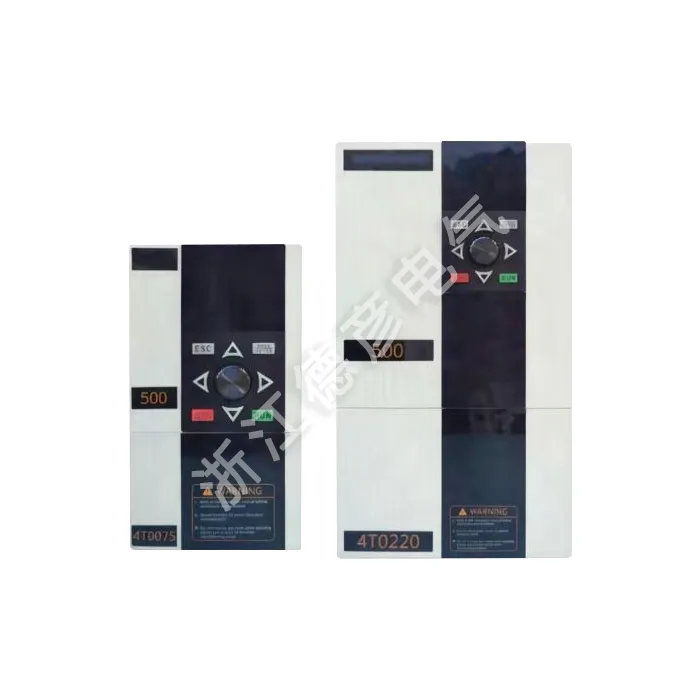
Deyan Electric's Variable Frequency Drive for Textile Equipment is built for the one thing every textile mill fears most: unplanned downtime. As a China manufacturer, we know that when a spinning frame stops, yarn breaks pile up. When a loom loses sync, fabric quality drops. This drive delivers 150% starting torque at 0.5Hz to get heavy machinery moving, holds ±0.5% speed accuracy to keep yarn tension consistent, and includes built-in swing frequency for winding applications—all backed by RS485 communication for integration with your existing monitoring systems.
Cotton dust is the real enemy
If you have ever opened a drive cabinet in a spinning mill, you know what comes next: a cloud of cotton dust, fly, and fiber particles. These particles clog cooling fans, coat circuit boards, and create insulation problems that lead to premature drive failure. Textile mills are among the harshest environments for electronic equipment, yet many drives are designed for clean, climate-controlled factories and simply cannot survive the reality of a textile production floor.
How this drive is built to survive the textile environment:
● Thermal design that accounts for dust: The drive's cooling architecture is designed to maintain reliable operation even when airflow is partially restricted by accumulated fiber. With an operating temperature range of -10℃ to +40℃ (and derated operation up to 50℃), it provides a thermal margin that keeps running when others shut down.
● Circuit board protection: While the drive itself is designed for indoor installation, its robust protection features—including overheat, overvoltage, and overcurrent protection with configurable shutdown levels—ensure that the drive protects itself before damage occurs, rather than failing catastrophically.
● Vibration tolerance: Textile machinery generates constant vibration from high-speed rotating components. This drive is rated for vibration up to 5.9m/s² (0.6g), meaning it stays reliable even when mounted on or near equipment that shakes and rattles through every shift.
The bottom line is simple: a drive that fails from cotton dust contamination costs you not just the replacement part, but the production time lost while the machine sits idle. This drive is designed to minimize that risk from day one.
Yarn breakage during startup — who pays for that?
In textile production, every yarn break during startup means lost time, wasted material, and a knot that weakens the final fabric. The problem is especially acute on spinning frames and winding machines, where the inertia of full bobbins and heavy rollers demands significant starting torque. A drive that cannot deliver that torque will either trip on overload or accelerate so slowly that yarn tension breaks.
What this drive delivers when it matters most:
1. Starting torque that handles the load: This drive delivers 150% of rated torque at 0.5Hz in open-loop vector control (SVC) mode. That means even when your spinning frame is fully loaded with bobbins, the drive has the muscle to get it moving without stalling or tripping.
2. Automatic torque boost: Instead of requiring manual tuning for every machine and every batch, the drive automatically boosts torque during acceleration to overcome initial inertia. This eliminates the guesswork and ensures consistent startup performance across different machines and different operators.
3. Slip compensation for consistent tension: As load varies during operation—when a yarn package builds up or when different materials are processed—motor slip changes. The drive's automatic slip compensation adjusts in real time to maintain accurate speed, which translates to consistent yarn tension and fewer breaks.
When you eliminate startup breaks, you eliminate the downtime that comes with re-threading and the waste that comes with discarded yarn. Over a year, those savings add up significantly.
Unstable tension creates fabric streaks
In weaving and knitting, speed consistency is everything. If the Variable Frequency Drive for Textile Equipment speed fluctuates even slightly, the fabric develops visible defects—streaks, uneven stitches, or tension marks that make the entire roll unsellable. The same problem exists in winding, where uneven speed creates packages with inconsistent density that cause problems downstream. Textile quality control starts with motor speed control, and speed control starts with the drive.
Precision that protects fabric quality:
● Speed accuracy that matters: In SVC mode, this drive maintains ±0.5% speed accuracy. In closed-loop vector control (FVC) mode with encoder feedback, it achieves ±0.02%. For a winding machine running at 1,500 RPM, that means the speed stays within 0.3 RPM of setpoint—variation so small it is invisible to the process and undetectable in the final fabric.
● Swing frequency for winding applications: Winding machines require the drive to oscillate speed slightly to create even yarn packages. This drive includes built-in swing frequency functionality, with fully adjustable center frequency and deviation parameters. You can set the swing pattern to match your specific winding requirements without needing external controllers or custom programming.
● Multiple frequency sources for flexible control: Whether your machine uses analog input from a tension sensor, digital setting from a panel, or RS485 commands from a central PLC, this drive supports all of them. You are not locked into a single control method—you can choose what works best for each machine and each process.
When fabric quality is on the line, precision is not optional—it is the difference between first-quality goods and seconds. This drive delivers the precision your weavers and knitters need.
Swing frequency? Fixed length? Counting? This drive handles it all
Textile machinery is not just about running a motor at a constant speed. Winding machines need swing frequency to build even packages. Warpers need fixed-length counting to ensure consistent beam sizes. Draw frames need counting functions to track production. In many mills, these functions require separate controllers, additional wiring, and complex programming—all of which add cost and create more points of failure.
Built-in textile-specific functions that eliminate external hardware:
1. Swing frequency: Precisely what winding applications need. The drive oscillates the output frequency around a center frequency, creating the even yarn layering that prevents package collapse and ensures smooth unwinding downstream. All parameters—center frequency, swing amplitude, and swing period—are adjustable through the drive's parameter set.
2. Fixed-length and counting functions: The drive includes built-in counting and fixed-length control. When the preset length is reached, the drive can trigger an output signal to stop the machine or alert the operator. This eliminates the need for separate counters and simplifies panel wiring.
3. Built-in PLC supporting 16-step speed operation: For machines that require multi-speed profiles—such as winders that change speed as the package builds, or draw frames that ramp speed during startup—the drive's internal PLC handles it. You program the speed sequence once and the drive executes it automatically, reducing operator intervention and ensuring consistency.
By consolidating these functions into a single drive, you reduce panel space, lower component costs, and simplify maintenance. One drive does the work of what used to require multiple devices.
Spent all day tuning parameters and still not right?
Anyone who has commissioned a textile drive knows the frustration. Dozens of parameters, cryptic codes, and trial-and-error adjustments that stretch into hours. Meanwhile, the machine sits idle and production targets slip. The problem is especially acute in textile mills where multiple machine types—spinning, weaving, winding, dyeing—each require different drive configurations.
How this drive gets you running faster:
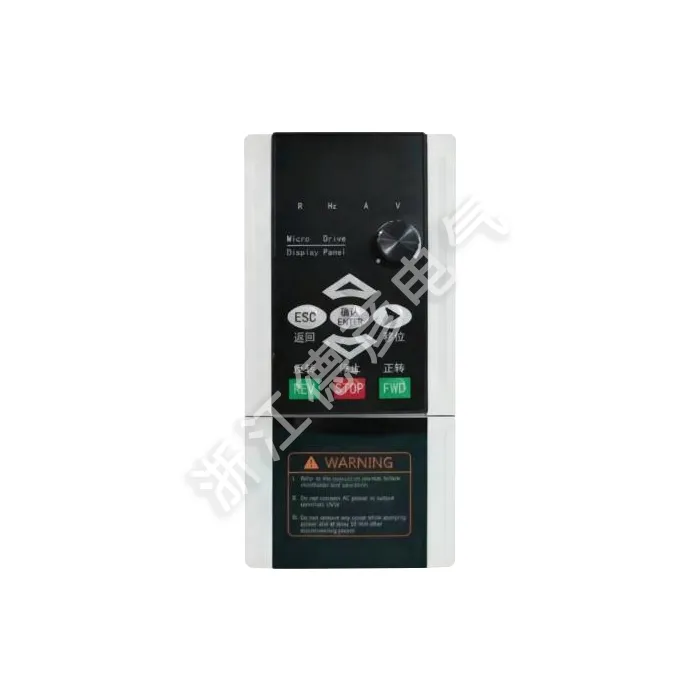
● Intuitive operator interface: The drive features an LED panel with 8 function keys, a 5-digit 7-segment display, and 5 status indicators. The menu structure groups textile-relevant parameters—swing frequency settings, acceleration/deceleration times, and PID parameters—in logical clusters so you are not hunting through irrelevant options.
● Parameter copying for fleet-wide consistency: Once you have tuned one machine perfectly, you can copy those parameters to other drives via the RS485 communication port. This ensures consistent performance across all machines and reduces setup time for new installations or replacements.
● Flexible frequency setting methods: Whether you prefer panel knob adjustment, analog input from a sensor, or digital commands from a PLC, the drive supports all of them. You choose the method that fits your existing control architecture without rewiring or redesigning.
A drive that takes hours to commission is a drive that costs you twice—once in the purchase price and again in lost production. This drive is designed to minimize that second cost.
Do you really need a separate PLC?
Many textile machines require basic logic control in addition to speed control—sequencing of multiple motors, interlocking with sensors, or automated startup/shutdown sequences. Traditionally, this has meant adding a separate PLC, which adds cost, takes up panel space, and introduces another component that can fail.
Built-in PLC that eliminates the extra box:
1. 16-step speed operation: The drive's internal PLC supports up to 16 programmable speed steps. This is ideal for machines like winders that need to change speed as the package builds, or for processes that require different speeds for different stages of operation.
2. Programmable digital inputs and outputs: With 5 digital input terminals (one configurable as high-speed pulse input) and multiple output terminals—including one high-speed pulse output, one digital output, one relay output, and two analog outputs—the drive can handle basic logic control without external components.
3. PID control built in: For processes that require closed-loop control—such as tension regulation using a load cell, or pressure control in dyeing machines—the drive includes advanced PID algorithms. You connect the sensor directly to the drive's analog input, set the PID parameters, and the drive handles the rest.
When you eliminate the separate PLC, you reduce cost, simplify wiring, and improve reliability. One component does the work of two, and there is one less thing to troubleshoot when something goes wrong.
How does it talk to your mill management system?
Textile mills are increasingly connected. Production data flows from machines to MES systems. Maintenance teams monitor equipment status remotely. Quality control tracks process parameters in real time. A drive that cannot communicate is a blind spot—it forces operators to walk to the machine for every status check and prevents the data collection that drives continuous improvement.
Connectivity that keeps you informed:
● Standard RS485 with Modbus protocol: Every drive comes with RS485 communication as standard. You can read real-time parameters—output frequency, motor current, DC bus voltage, and temperature—directly from your PLC or monitoring system. You can also issue start, stop, and speed commands remotely, eliminating the need for operators to interact with the drive panel for routine operations.
● Real-time diagnostics for predictive maintenance: By monitoring current draw and temperature trends over time, you can detect developing issues—bearing wear, insulation degradation, or cooling problems—before they cause failures. This shifts maintenance from reactive to proactive, reducing unplanned downtime.
● Optional communication cards for flexibility: For mills that use other fieldbus protocols, optional isolated communication cards are available. The drive also supports multiple encoder types—differential, open-drain, UVW, and resolver—so you are not locked into a single feedback technology.
In a connected mill, data drives decisions. This drive gives you the data you need to make better decisions about production, maintenance, and quality.
When it matters most, it cannot fail
Textile production runs around the clock. When a drive fails at 2 AM on a Saturday, getting a replacement or a service technician is not easy. The cost of that downtime is not just the lost production—it is the overtime pay, the expedited shipping for parts, and the missed delivery deadlines that damage customer relationships. Reliability is not a nice-to-have in textiles; it is a business imperative.
Built-in protection that prevents failures:
1. Comprehensive protection functions: The drive includes overvoltage, overcurrent, overload, overheat, and short-circuit protection. Overvoltage and overcurrent shutdown levels are configurable, allowing you to fine-tune protection to match your specific application without nuisance tripping.
2. Motor short-circuit detection upon power-on: The drive checks for motor short-circuits every time it powers up, catching wiring problems before they cause damage. This is especially valuable in textile mills where vibration can loosen connections over time.
3. Input and output phase-loss protection: Unstable power is common in industrial environments. The drive monitors both input and output phases and shuts down safely if a phase is lost, preventing motor damage and further downtime.
4. Two-stage frequency hopping to avoid resonance: Mechanical resonance can cause vibration that damages both the machine and the drive. The drive allows you to program two frequency bands to be skipped automatically, avoiding resonance points without operator intervention.
Protection is not about avoiding the inevitable—it is about making the inevitable survivable. When something goes wrong, this drive protects itself and your equipment, minimizing damage and getting you back online faster.
Key specifications at a glance
Beyond the functional benefits, procurement and engineering teams need to verify that the drive's specifications align with their machine requirements. The table below consolidates the critical technical data for the Variable Frequency Drive for Textile Equipment, all derived from actual factory specifications.
|
Power Range
|
0.75KW~5.5KW (220V), 0.75KW~750KW (380V)
|
|
Output Frequency
|
0~500Hz
|
|
Carrier Frequency
|
0.8kHz~12kHz (automatically adjustable based on load)
|
|
Output Frequency Resolution
|
Digital: 0.01Hz; Analog: Maximum frequency × 0.025%
|
|
Control Modes
|
Open-loop vector control (SVC), V/F control, Closed-loop vector control (FVC)
|
|
Starting Torque
|
150% at 0.5Hz (SVC)
|
|
Torque Control Accuracy
|
SVC: Above 5Hz ±5%; FVC: ±3%
|
|
Speed Regulation Range
|
1:200 (SVC), 1:1000 (FVC)
|
|
Speed Stabilization Accuracy
|
±0.5% (SVC), ±0.02% (FVC)
|
|
Overload Capacity
|
150% of rated current for 60 seconds
|
|
Acceleration/Deceleration Time
|
0.1~6500.0s (linear or S-curve)
|
|
DC Braking
|
Braking frequency: 0.00Hz~max; Braking time: 0.0s~36.0s
|
|
Digital Inputs
|
5 terminals (one configurable as high-speed pulse input)
|
|
Analog Inputs
|
2 channels: AI1 (0~+10V), AI2 (0~+10V / 0~20mA)
|
|
Output Terminals
|
1 high-speed pulse output, 1 digital output, 1 relay output, 2 analog outputs
|
|
Communication
|
RS485 with Modbus protocol (standard)
|
|
Braking Unit
|
Built-in for 22kW and below
|
|
Optional Cards
|
IO expansion, communication card (isolated), PG card
|
|
Encoder Support
|
Differential, open-drain, UVW, resolver
|
|
Ambient Temperature
|
-10℃~+40℃ (derating for 40℃~50℃)
|
|
Altitude
|
Less than 1000m
|
|
Humidity
|
Less than 95% RH, without condensation
|
|
Vibration
|
Less than 5.9m/s² (0.6g)
|
|
Storage Temperature
|
-20℃~+60℃
|
These numbers matter because they translate directly to textile production outcomes. The wide power range covers everything from small draw frames to large dyeing machines. The speed accuracy ensures consistent fabric quality. The overload capacity handles the sudden torque demands of heavy startup loads. And the environmental specifications confirm that this drive is built for the textile floor, not the lab.
Deyan Electric: the power behind textile production
Deyan Electric was founded in 2020 in Yueqing, Zhejiang—the heart of China's electrical industry. In a short time, the company has built a reputation for quality and innovation, operating with a philosophy of "surviving by quality and developing by innovation". Every Variable Frequency Drive for Textile Equipment is manufactured under strict quality control protocols and subjected to comprehensive factory testing before shipment.
What you get when you choose Deyan Electric:
1. Manufacturing integrity: Our facilities operate with ISO-certified processes. Every drive undergoes full-load burn-in and communication verification before it leaves the factory, ensuring that what arrives on your floor is ready to run.
2. Component quality: We use premium-grade IGBTs and capacitors from established suppliers. Our thermal management design is validated to ensure continuous operation at ambient temperatures up to 40℃, with derating capability up to 50℃—meaning reliable performance even in poorly ventilated machine enclosures.
3. Application expertise: We understand textile production because we work with textile producers. Our technical support team can help with parameter tuning for specific applications—whether you are setting up a new winding machine or optimizing a weaving line.
4. Warranty and support: Our warranty reflects our confidence in the drive's durability. And when you need help, our team is responsive, ensuring that you are never left to solve problems alone.
Choosing Deyan Electric means choosing a supplier that understands the real pressures of textile production. We are not just selling a drive; we are providing a tool that helps your mill run better, with less waste and more consistent quality. That is the foundation of a partnership built on mutual success.
Frequently Asked Questions
Q: What makes this drive different from a general-purpose VFD for textile applications?
A: This drive includes textile-specific features—swing frequency for winding, fixed-length counting, and 16-step PLC functionality—that are built in rather than requiring external add-ons. It is also designed with the thermal and environmental challenges of textile mills in mind, with robust protection features that survive the dust and heat of a production floor.
Q: How does the swing frequency function work for winding applications?
A: The drive oscillates the output frequency around a set center frequency. You can adjust the swing amplitude (how much the frequency varies) and the swing period (how fast it oscillates). This creates the even yarn layering that prevents package collapse and ensures consistent yarn tension throughout the winding process.
Q: What happens if the drive gets clogged with cotton dust?
A: The Variable Frequency Drive for Textile Equipment is designed with thermal protection that shuts down safely before overheating occurs. While no drive is immune to extreme dust accumulation, this drive's thermal design provides a margin that keeps it running longer in dusty environments. Regular cleaning of cooling fans and heat sinks is still recommended as part of preventive maintenance.
Q: Can this drive be used with both new and existing textile machinery?
A: Yes. The drive supports multiple control methods—panel, analog input, and RS485—so it can interface with both modern PLC-controlled machines and older equipment that uses analog signals. The wide power range also covers most textile machine sizes.
Q: How does the built-in PLC help with textile applications?
A: The built-in PLC supports up to 16-step speed operation, which is ideal for machines that require speed changes during a cycle—such as winders that slow down as the package builds, or machines that have different speeds for different stages of operation. It eliminates the need for a separate PLC controller.
Q: What communication options are available for integration with our mill's monitoring system?
A: The drive comes standard with RS485 communication supporting Modbus protocol. This allows you to read real-time parameters—speed, current, voltage, temperature—and issue commands from a central PLC or SCADA system. Optional communication cards are available for other fieldbus protocols.
Q: What is the typical service life of this drive in a textile mill environment?
A: With proper installation, adequate cooling, and regular preventive maintenance (including cleaning of cooling fans and heat sinks), these drives typically exceed 10 years of service life. The use of premium-grade components and comprehensive protection circuits ensures long-term reliability even in demanding textile environments.