
Abstract
This professional electrical engineering article elaborates on standardized design, DIN-compliant manufacturing, environmental adaptability and multi-scene deployment advantages of European-style Cable Junction Box, a core cable connection device for 12kV medium voltage power distribution networks. The article systematically analyzes its modular compact structure, dual-door maintenance architecture, corrosion resistant shell material and full set of withstand voltage performance indicators. Complete specification tables, classified application lists and technical FAQ panels are provided for power grid designers, construction contractors and facility operation teams.
- 1. Industry Pain Points Solved By Standardized Cable Branch Equipment
- 2. Complete Official Technical Specification Parameter Table
- 3. Five Core Structural & Material Advantages
- 4. Global Applicable Power Distribution Construction Scenarios
- 5. DIN Standard Compliance & Internal Busbar Connection Logic
- 6. Step-by-Step Standard Field Installation Process
- 7. Technical Frequently Asked Questions For Engineering Teams
- 8. Long-Term Circuit Protection Value For Urban Power Grids
- 9. Official Professional Engineering Support Channel

1. Industry Pain Points Solved By Standardized Cable Branch Equipment
Traditional on-site cable branch construction faces persistent structural defects including messy wire layout, insufficient mechanical protection and poor environmental resistance, which easily trigger hidden circuit hazards over long-term operation. European-style Cable Junction Box is developed to address these universal construction pain points by referencing European DIN power distribution standards, adopting prefabricated modular architecture to unify cable branch layout and physical protection standards for medium voltage projects.
Conventional cable joint processing relies fully on manual on-site winding and insulation wrapping. Uneven construction quality between different construction teams creates inconsistent insulation performance, and exposed joint sections lack closed metal shielding against external impact and rainwater erosion. In contrast, this standardized junction box integrates fixed busbar butt sleeves and independent cable routing partitions inside the sealed shell, eliminating irregular cross-over layout of three-core cables that often appear in on-site hand-made joints.
For outdoor power distribution projects such as wind farms and suburban secondary substations, seasonal temperature fluctuation, dust accumulation and rainwater splashing will accelerate insulation aging of unprotected cable joints. The fully enclosed corrosion-resistant shell structure of this junction box forms a stable independent protection space for all internal connection points, greatly extending the service cycle of cable branch sections and reducing routine circuit inspection workload for operation staff.
Many old-style cable branch facilities require partial disassembly of the entire joint structure for inspection and maintenance, leading to repeated damage to insulation layers during repeated disassembly. The dual-opening door layout built into this European standardized design enables staff to observe internal busbar connection status and conduct partial testing without complete disassembly of cable fixation components, realizing maintenance-free long-term stable operation under regular patrol management.
- Modular prefabricated internal structure avoids irregular manual cable cross layout
- Dual-opening independent access doors simplify daily patrol and partial maintenance work
- Integrated welded busbar sleeves follow DIN 47636 industrial connection standards
- High impact resistant sealed shell delivers IP33 all-weather environmental protection
- Pre-positioned cable separation partitions eliminate three-core cable large-span crossing risks
2. Complete Official Technical Specification Parameter Table
All mass-produced batches of European-style Cable Junction Box adopt unified medium voltage power distribution test standards, with each electrical performance index verified through full third-party withstand and short-circuit stability testing before factory delivery. The complete standardized parameter set is sorted in the table below, which can be directly quoted for electrical drawing design and load matching calculation by engineering designers.
| Test Parameter Item | Unit | Standard Fixed Value |
|---|---|---|
| Rated Operating Voltage | kV | 12 |
| Rated Continuous Current | A | 630 |
| Dynamic Short-Circuit Stability Current | kA / 0.3s | 50 |
| Thermal Short-Circuit Stability Current | kA / 3s | 20 |
| 1-Minute Power Frequency Withstand Voltage | kV | 42 |
| 15-Minute DC Withstand Voltage | kV | 52 |
| Lightning Impulse Withstand Voltage | kV | 105 |
| Whole Enclosure Protection Grade | / | IP33 |
The IP33 enclosure protection rating represents two layers of environmental defense capability. The first digit 3 blocks solid foreign objects with diameter larger than 2.5mm from entering the internal connection cavity, preventing gravel, metal fragments and construction dust from contacting live busbars. The second digit 3 blocks vertical and 60-degree oblique splashing rainwater, adapting to outdoor semi-open distribution station, roadside cable trench and underground cable well working environments without extra customized waterproof modification.
The fixed 630A rated current specification matches mainstream medium voltage cable branch demand of industrial parks and commercial complexes. The matched bolted busbar joint structure ensures uniform pressure on contact surfaces during long-term current transmission, avoiding local overheating faults caused by loose joint contact points under seasonal temperature expansion and contraction cycles.
3. Five Core Structural & Material Advantages
The overall development logic of European-style Cable Junction Box focuses on solving five major weak points of traditional cable branch devices: messy wiring layout, complex maintenance disassembly, insufficient weather resistance, unstable busbar connection and complicated on-site assembly procedures. Each structural module passes long-term aging cycle testing before mass production, forming five distinct competitive advantages for medium voltage construction projects.
3.1 Compact Modular Integrated Layout
- Integrated internal partition plates divide independent wiring channels for each single-core cable, completely isolating three-core cables to eliminate cross-winding layout that easily creates insulation friction damage.
- The whole shell adopts streamlined miniaturized dimension design, occupying smaller installation space in narrow cable trenches and underground pipe corridors compared with traditional large-sized cable junction equipment.
- All busbar butt sleeves are pre-fixed inside the box during factory production, removing the need for on-site cutting and bending of conductive copper bars by construction teams.
- Standardized cable inlet and outlet reserved ports match mainstream medium voltage cable outer diameter specifications, without customized hole cutting on site during installation.
3.2 Dual Independent Opening Maintenance Doors
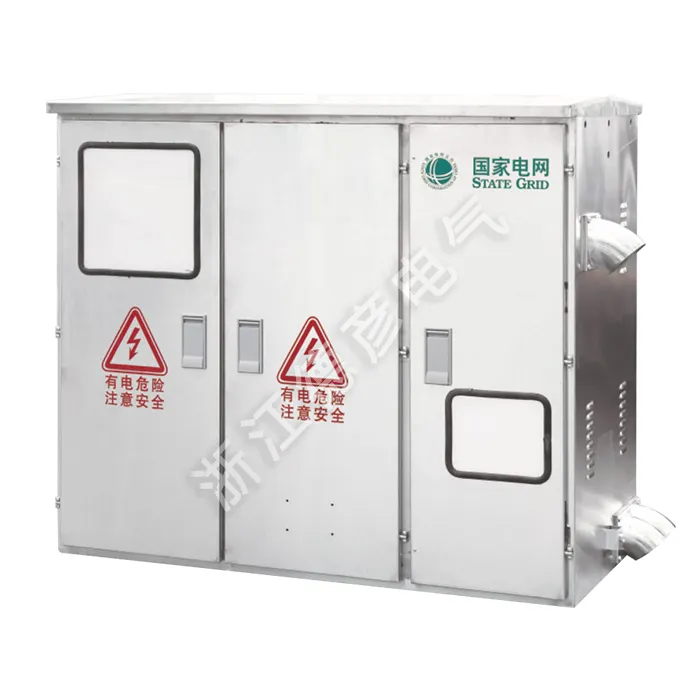
The upper and lower parts of the junction box shell are equipped with separate lockable access doors, corresponding to busbar connection area and cable wiring area respectively. When operation staff conduct routine patrol inspection, only the upper small door needs to be unlocked to observe busbar joint temperature and contact state without touching the fixed cable wiring section below. For cable replacement or branch expansion work, only the lower wiring door can be opened independently, keeping the main busbar connection cavity sealed to prevent dust and moisture invasion during partial construction operations.
3.3 High-Impact Corrosion Resistant Enclosure
The outer shell is manufactured from thickened anti-corrosion alloy plate with integrated bending and butt welding forming technology, eliminating welding gap leakage hidden danger that exists in spliced thin plate shells. The surface adopts multi-layer anti-rust electrostatic spraying process, resisting acid rain erosion, saline environment corrosion and long-term ultraviolet aging for outdoor long-term deployment. Even in coastal industrial zones and chemical park distribution networks, the shell maintains complete structural rigidity and sealing performance for multiple operation cycles.
3.4 DIN Standard Busbar Butt Connection System
All internal conductive connection components strictly comply with DIN 47636 European power distribution industrial standards, adopting standardized bolted butt-welded sleeves as core busbar connectors. Uniform contact pressure is formed on the copper bar joint surface after bolt locking, stabilizing conductive cross-section under long-term alternating current transmission, and effectively reducing contact resistance and local overheating risk during peak load periods. Standardized connector specifications realize interchangeability between different project batches of junction boxes, simplifying spare part storage management for operation teams.
3.5 Fast On-Site Assembly Without Complex Processing
All internal conductive components and cable fixing fixtures are pre-installed inside the box before factory delivery. Construction personnel only need to lead medium voltage cables into reserved inlet ports and complete bolt locking of cable terminals with pre-installed busbar sleeves, without extra insulation wrapping, copper bar cutting and on-site welding work required for traditional cable joints. The whole single branch assembly process can be finished in a short time, greatly improving medium voltage cable laying construction efficiency for large-scale power grid expansion projects.
4. Global Applicable Power Distribution Construction Scenarios
The balanced combination of compact dimension, all-weather protection and standardized DIN connection technology makes this cable junction box applicable to nearly all mainstream medium voltage cable network construction projects across global regions. Classified applicable construction sites are sorted below to provide clear equipment selection reference for electrical designers of different industry projects.
- Compact urban underground secondary substations: Narrow cable corridor cable branch connection equipment for downtown central distribution networks
- Small and medium industrial mining enterprises: Workshop medium voltage trunk line branch nodes for factory power supply systems
- Onshore wind power generation plants: Fan box transformer outgoing cable branch devices adapting to outdoor humid and dusty environments
- Large commercial complex facilities: Shopping malls, hotels and office building underground cable well branch connection units
- Residential centralized community power grids: Urban residential district buried medium voltage cable network branch protection equipment
- New energy storage station projects: Energy storage unit medium voltage incoming and outgoing cable branch junction facilities
Different project environments have targeted equipment deployment suggestions: Wind power and coastal industrial zone projects can match auxiliary external rainproof shielding accessories to further extend shell anti-corrosion service life; urban underground cable well deployment only requires standard factory configuration without extra auxiliary structural parts; indoor commercial power distribution rooms can directly adopt basic compact specifications due to stable indoor temperature and humidity conditions without complex weather resistance matching.
5. DIN Standard Compliance & Internal Busbar Connection Logic
The core internal conductive connection system of European-style Cable Junction Box follows DIN 47636 European cable joint manufacturing specifications, which sets unified dimensional tolerance, contact pressure and conductive material purity standards for medium voltage busbar butt sleeves. The standard formulation originates from decades of European urban cable network operation data, summarizing long-term stability requirements of cable branch joints under alternating peak current, temperature cycle change and environmental erosion conditions.
The internal connection logic adopts a one-to-one independent busbar sleeve matching mode: each incoming cable core corresponds to an independent butt-welded copper sleeve, and three single-core cable connection areas are completely separated by insulated partition plates inside the box. This layout avoids cross-conduction interference between different phase cables, and prevents short-circuit faults caused by insulation aging friction between adjacent cable cores during long-term vibration operation of underground cable trenches.
The bolted locking structure of the busbar sleeve realizes detachable connection mode. When project later expansion requires adding new cable branch circuits, construction staff can unlock partial busbar sleeves without replacing the whole junction box unit, directly matching new cable terminals to complete branch expansion transformation. This detachable connection design greatly improves the reusability of the whole junction box equipment, avoiding complete replacement of cable branch facilities during load capacity upgrade of power distribution networks.
6. Step-by-Step Standard Field Installation Process
The prefabricated modular design simplifies on-site installation steps significantly, and standardized operation procedures can reduce construction error probability during cable branch assembly. The complete field installation flow is divided into six sequential operation steps as listed below.
- Carry out pre-installation inspection of the junction box unit: Check shell sealing integrity, busbar sleeve locking state and internal partition plate fixing firmness before transporting to construction site.
- Complete positioning and fixing of the whole box in cable trench or underground cable well: Use special fixed support brackets to lock the junction box horizontally to avoid long-term cable tension pulling the shell to generate structural deformation.
- Lead medium voltage cables into reserved inlet and outlet ports, adjust cable length to reserve sufficient maintenance margin inside the box cavity, fix cable outer sheath with built-in wire clamps.
- Strip cable insulation layer according to standard length, connect cable copper terminals to pre-installed busbar butt sleeves, lock fixing bolts with standard torque tools to guarantee uniform contact pressure.
- Close internal wiring partition plate, lock lower cable maintenance door, fill cable inlet gaps with matched sealing filler to block dust and rainwater infiltration channels.
- Carry out visual inspection of internal busbar connection through upper observation door, confirm no loose bolts or cable extrusion deformation, then lock upper maintenance door to finish installation.
Strict torque specification control during bolt locking is the core guarantee of long-term stable joint performance. Excessively loose bolts will cause increased contact resistance and local heating under load current; over-tightened bolts will deform copper busbar sleeves, damaging internal conductive structure and shortening joint service cycle. Standard matched torque tools are recommended for all on-site assembly operations to unify locking force of all busbar connection points.
7. Technical Frequently Asked Questions For Engineering Teams
8. Long-Term Circuit Protection Value For Urban Power Grids
Large-scale standardized deployment of European-style Cable Junction Box brings continuous long-term operation benefits for municipal and industrial medium voltage cable networks, focusing on circuit fault risk reduction and simplification of daily operation management without involving any cost or expenditure analysis content.
First, the fully sealed independent protection cavity isolates cable branch joints from external environmental erosion factors including dust, rainwater and chemical gas, slowing insulation aging speed of cable connection sections significantly. Traditional exposed on-site joints face rapid insulation degradation after several years of outdoor operation, triggering short-circuit hidden dangers; standardized sealed junction boxes maintain stable insulation performance for longer operation cycles, reducing circuit fault frequency of urban cable networks.
Second, the separated dual-door maintenance structure lowers operation safety risks during daily patrol and inspection work. Staff do not need to fully disassemble cable fixing structures to observe busbar joint status, avoiding accidental cable pulling and insulation damage caused by repeated disassembly operations. Independent wiring and busbar access cavities separate live conductive parts from external operation space, lowering accidental electric shock risks during routine inspection work of distribution networks.
Third, unified DIN standard connection components realize cross-project interchangeability of spare parts for power grid operation teams. Different municipal construction batches of junction boxes adopt identical busbar sleeve specifications, so operation maintenance departments do not need to reserve multiple types of spare conductive components, simplifying spare parts storage classification and daily inventory management work of power distribution operation stations.
9. Official Professional Engineering Support Channel
Zhejiang Deyan Electric Co.,Ltd. integrates medium voltage cable connection equipment, high and low voltage switchgear independent research and development, standardized manufacturing and global engineering matching service. All cable junction products pass complete short-circuit stability, withstand voltage and environmental aging third-party testing before factory delivery, supplying standardized power distribution hardware solutions for municipal power grids, new energy projects and industrial park construction projects across multiple global regions.
Electrical design engineers, municipal engineering contractors and facility operation management teams requiring complete equipment dimension drawings, full performance test reports and project layout matching consultation can submit cooperation inquiries through the official dedicated service channel.